
Aug 13, 2021
YouTube 1:06:39
Video
Cancer and Apitherapy Part 1
Cancer and Apitherapy Part 1
Description
Overview
This video features an in-depth presentation on research conducted over more than ten years regarding propolis, a bee-derived natural product, and its potential role in breast cancer treatment. The discussion includes contributions from researchers and medical oncologists who examine the complexity of breast cancer subtypes, the limitations of current conventional therapies, and how propolis and its bioactive compounds might exert multi-targeted anticancer effects.
Breast Cancer: Prevalence and Types
Breast cancer is highlighted as the most commonly diagnosed cancer in women worldwide, with approximately 2.3 million new cases annually. It remains a leading cause of cancer-related death among women, especially in developing countries. The presentation notes that one in eight women may develop breast cancer during their lifetime.
Breast cancer occurs in various forms, with significant differences in aggressiveness and treatment response. The video outlines three primary breast cancer types:
- Hormone-responsive breast cancer: Constituting 50-70% of cases, this type expresses estrogen and progesterone receptors. It generally has a better prognosis and is treated with endocrine therapies that block estrogen stimulation.
- HER2-positive breast cancer: Making up about 20% of cases, this subtype overexpresses the HER2 receptor and is highly aggressive. Targeted therapies such as trastuzumab are available, but resistance develops in many patients, limiting treatment efficacy.
- Triple-negative breast cancer (TNBC): The most aggressive form, lacking estrogen, progesterone, and HER2 receptors. TNBC has no targeted therapies, high recurrence rates, and often poor response to chemotherapy. It is more common in younger women under 45.
The speakers emphasize the urgent need for novel treatments that can target multiple cellular pathways simultaneously to overcome tumor heterogeneity and resistance mechanisms.
Challenges in Conventional Breast Cancer Treatments
Current chemotherapy agents primarily induce DNA damage or trigger apoptosis in cancer cells. However, cancer cells can develop resistance through various mechanisms, including switching signaling pathways or altering their phenotype during treatment. Additionally, tumors often consist of heterogeneous cell populations, meaning some cells may evade therapy and cause relapse.
The concept of "confusing the complex system with many weak hits" is introduced, suggesting that multi-targeted approaches using compounds with diverse mechanisms may be more effective than single-target therapies.
Propolis: Composition and Variability
Propolis is described as a complex natural substance containing over 300 identified compounds, including polyphenols, flavonoids, and caffeic acid phenethyl ester (CAPE). Its chemical composition varies depending on geographic origin, botanical sources, and extraction methods, which influence its biological activity.
Common types of propolis include:
- Antolin propolis: Brownish in color, common in Europe and North America.
- Brazilian green propolis: Noted for its distinct green color and unique bioactive profile.
Extraction methods, such as ethanol extraction, affect the yield and spectrum of compounds obtained.
Laboratory Studies on Propolis and Breast Cancer Cells
Research presented includes studies evaluating different propolis samples on various breast cancer cell lines representing hormone-responsive, HER2-positive, and triple-negative subtypes. Key findings include:
- Propolis samples induced apoptosis selectively in cancer cells while sparing healthy fibroblasts and breast epithelial cells, indicating safety for normal tissues.
- Gene expression analyses revealed that propolis treatment downregulated genes involved in cell cycle progression, DNA repair, and stress response, while upregulating apoptosis and immune response pathways.
- The most effective propolis samples contained a diverse range of polyphenolic compounds, suggesting that the synergistic effects of multiple constituents contribute to anticancer activity.
The studies highlight the importance of analyzing propolis samples for contaminants such as heavy metals and pesticides before clinical use.
Mechanisms of Anticancer Action of Propolis and CAPE
The video details several mechanisms by which propolis and its active compound CAPE may exert anticancer effects:
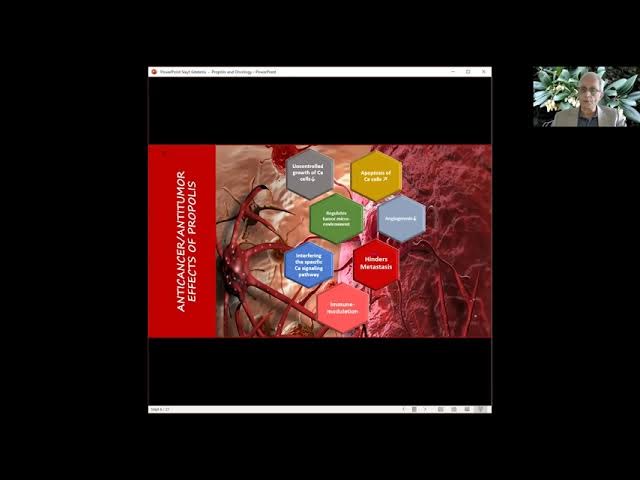
- Antioxidant and anti-inflammatory effects: Propolis scavenges free radicals, inhibits oxidases, and reduces inflammatory cytokines, which are factors involved in cancer initiation and progression.
- Selective induction of apoptosis: CAPE triggers apoptosis in cancer cells via pathways such as TRAIL (tumor necrosis factor-related apoptosis-inducing ligand) and caspase activation, without harming normal cells.
- Inhibition of tumor growth and metastasis: Propolis blocks angiogenesis by suppressing vascular endothelial growth factor (VEGF) signaling, regulates the tumor microenvironment, and inhibits matrix metalloproteinases (MMPs) that degrade extracellular matrix components essential for metastasis.
- Immune system modulation: Propolis enhances the activity and number of cytotoxic T cells (CD8+), helper T cells (CD4+), and natural killer (NK) cells, increasing cytokine production such as interleukin-2 and interferon-gamma, thereby supporting the body's immune response against tumors.
- Adjuvant effects: Propolis increases cancer cell sensitivity to chemotherapy and radiotherapy by downregulating drug resistance genes (e.g., MDR1), reducing efflux pump activity, and protecting against organ damage and side effects induced by conventional treatments.
Animal studies cited demonstrate that propolis can prevent chemotherapy-induced toxicities, maintain blood biochemical parameters, and reduce organ damage, although these findings are primarily preclinical.
Clinical Evidence and Applications
Despite promising laboratory and animal data, clinical trials investigating propolis as a cancer treatment are limited. The main clinical application of propolis in oncology to date is in managing oral mucositis, a painful inflammation of the mouth commonly caused by chemotherapy and radiotherapy.
A meta-analysis of randomized controlled trials involving patients with head and neck or breast cancer found that propolis gargles significantly reduced symptoms and complications of oral mucositis during cancer treatment.
The presenters emphasize the need for further clinical research to explore propolis’s potential as a complementary therapy in cancer treatment, including its safety, efficacy, and mechanisms in humans.
Synergistic Effects of Propolis Components
The video highlights that the combined effect of multiple polyphenols and flavonoids in propolis is greater than the sum of individual components. For example, the flavonoid fraction of propolis showed significantly higher anticancer activity compared to isolated flavonoids such as pinobanksin or kumaric acid. This synergy is considered a natural advantage of propolis as a multi-targeted agent.
Safety Considerations
Propolis samples must be carefully analyzed for contaminants such as heavy metals and pesticides due to environmental factors affecting bee products. The selective action of propolis and CAPE on cancer cells without damaging normal cells is a key safety feature noted in the research.
Summary and Future Directions
The video concludes that propolis, with its complex mixture of bioactive compounds, shows promise as a multi-targeted agent against breast cancer. Its antioxidant, anti-inflammatory, pro-apoptotic, anti-angiogenic, anti-metastatic, and immune-modulating properties may complement existing therapies and help overcome treatment resistance.
However, the presenters stress that clinical evidence remains scarce, and more rigorous human studies are needed to validate propolis’s role in cancer therapy and to establish standardized preparations and dosing.
Source Information
This video is an educational resource from the American Apitherapy Society, featuring presentations by researchers and medical oncologists involved in propolis and cancer research. It includes scientific data, experimental results, and expert commentary on the potential role of bee products in cancer treatment, particularly breast cancer. The content is based on laboratory and animal studies, with limited clinical trial data, and should be interpreted as exploratory rather than conclusive medical advice.