


1981
Book
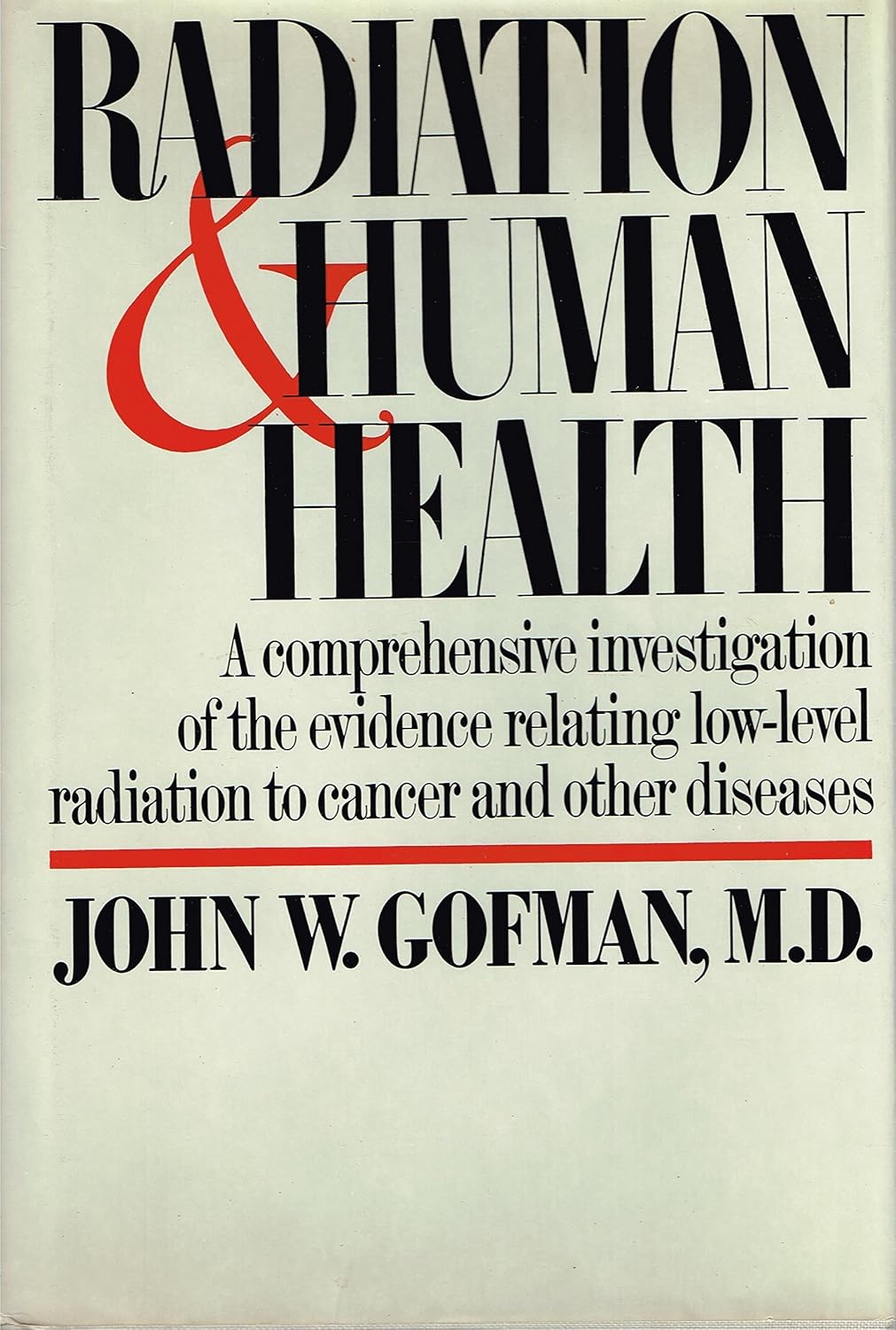
Radiation and human health
PublisherRandom House, Inc.
Pub Year1981
Page Count908
ISBN9780871562753
Amazon
Description
Radiation and Human Health — Comprehensive Summary
Scope and Purpose: "Radiation and Human Health" by John W. Gofman (1981) is an extensive, scientifically rigorous examination of the health effects of ionizing radiation, with a primary focus on cancer induction, genetic and chromosomal damage, and public health implications. Spanning over 900 pages, the book synthesizes epidemiological data, radiobiological mechanisms, dosimetry principles, and genetic research to provide a quantitative and qualitative assessment of radiation risks, particularly at low doses. It aims to clarify misconceptions, present evidence-based risk estimates, and advocate for informed public health policies and medical practices.
Intended Audience: The book is directed toward a broad professional audience including medical practitioners, radiation workers, public health officials, environmentalists, epidemiologists, scientists, attorneys, journalists, and patients concerned with radiation exposure. Its detailed methodology, extensive referencing, and quantitative analyses also make it a valuable resource for researchers and policymakers involved in radiation safety and cancer prevention.
Introduction and Fundamental Concepts
The opening chapters establish foundational knowledge about ionizing radiation, its physical properties, and biological effects. Ionizing radiation is characterized by its ability to remove electrons from atoms, producing ions that can disrupt molecular structures, particularly DNA, leading to cancer, leukemia, and hereditary chromosomal damage. The book introduces key units and concepts such as rad, curie, biological half-life, internal versus external exposure, cancer dose, doubling dose, linearity of dose-response, and risk quantification.
Gofman emphasizes the importance of distinguishing epidemiological evidence from anecdotal reports and advocates for rigorous, evidence-based conclusions supported by transparent methodologies. The book excludes acute radiation sickness and non-cancerous effects to maintain focus on carcinogenesis and genetic damage.
Radiation Physics and Energy Transfer
The text details the physics of radiation, including the nature of radioactive decay, types of ionizing radiation (alpha, beta, gamma, X-rays), and their interactions with matter. It explains mechanisms such as the photoelectric effect, Compton scattering, and pair production, which govern energy transfer to biological tissues. Linear Energy Transfer (LET) is introduced as a critical factor influencing biological damage, with alpha particles having high LET and thus greater carcinogenic potential when internalized.
Cancer Origins and Radiation Causation
Gofman explores the multifactorial origins of cancer, highlighting ionizing radiation as a proven carcinogen that statistically increases cancer incidence in exposed populations. Cancer arises from single cells undergoing genetic and chromosomal alterations, often in the DNA within the nucleus. Radiation-induced cancers are indistinguishable from spontaneous cancers, indicating shared pathogenic mechanisms.
The book discusses the challenges of detecting low-dose radiation effects due to statistical limitations and underscores the value of molecular and cellular studies to complement epidemiological data. It also addresses the latency periods of radiation-induced cancers, which can range from under five to over fifty years post-exposure.
Chromosomal Damage and Genetic Effects
A significant portion of the book is devoted to chromosomal biology and radiation-induced chromosomal abnormalities. Human cells normally contain 46 chromosomes, but radiation exposure can cause deletions, translocations, inversions, dicentric chromosomes, and polyploidy, all of which may contribute to carcinogenesis and hereditary diseases.
The author reviews cytogenetic evidence linking chromosomal aberrations to cancer initiation and progression, as well as to congenital anomalies. The Boveri hypothesis—that cancer arises from chromosomal imbalances disrupting cellular regulation—is discussed in depth. Radiation-induced chromosomal damage is shown to increase linearly with dose, and hereditary chromosomal abnormalities are identified as risk factors for specific cancers.
Quantitative Radiation Carcinogenesis and Risk Estimation
Gofman systematically analyzes epidemiological data from atomic bomb survivors, medical radiation patients, and occupationally exposed workers to estimate cancer risks per unit dose. He discusses dose units (rad, gray, rem), dose measurement complexities, and the importance of considering age at exposure, dose fractionation, and body fraction irradiated.
Key findings include:
- Peak cancer risk per rad decreases with increasing age at exposure.
- Organ-specific cancer risks vary widely, with thyroid and kidney cancers showing high sensitivity to radiation.
- Leukemia induction follows a linear dose-response with no threshold after accounting for residual radiation.
- Medical radiation exposures, particularly from fluoroscopy and nuclear medicine, contribute significantly to population cancer risk.
Internal Alpha Emitters: Radium, Radon, and Plutonium
The book dedicates several chapters to the health effects of internal alpha-particle emitters, which pose high carcinogenic risks when incorporated into the body. Radium-226 accumulates in bone, causing bone cancers, while radon and its decay products increase lung cancer risk, especially in uranium miners and smokers.
Plutonium and other transuranic elements, produced in nuclear reactors and weapons programs, are highlighted for their long half-lives and potent alpha emissions. Inhalation of insoluble plutonium oxides results in localized lung doses with significant cancer risk. Smoking exacerbates plutonium retention and lung cancer incidence.
The author estimates that global plutonium fallout from atmospheric nuclear testing could be responsible for nearly one million lung cancer deaths worldwide, though direct epidemiological evidence remains limited due to latency and detection challenges.
Radiation Exposure in the Nuclear Industry and Environment
Gofman critically examines radiation doses from nuclear power operations, including routine releases and waste disposal. Despite industry claims of low public doses, the book argues that permissible limits have historically been set too high and that containment failures could lead to significant public health impacts.
Environmental pathways for radionuclide uptake, such as through air, water, and food chains, are discussed with attention to uncertainties in transfer factors and dose estimates. The cumulative effects of low-level exposures from natural sources, consumer products, and occupational settings are also analyzed.
Medical Radiation: Risks and Practices
Medical X-rays are identified as the largest source of man-made radiation exposure. The book documents wide variability in doses across facilities and procedures, often due to outdated equipment or lack of dose optimization. Gofman stresses the importance of organ dose over skin dose for cancer risk assessment and calls for improved physician and patient awareness regarding radiation risks and benefits.
Nuclear medicine therapies, particularly with radioiodine (^131I), are scrutinized for their potential to induce fatal cancers. The author advocates for informed consent and more rigorous scientific evaluation of therapeutic radiation doses and long-term outcomes.
Leukemia and Radiation
Leukemia induction by ionizing radiation is reviewed with emphasis on dose-response relationships derived from atomic bomb survivor data and military test exposures. Leukemia risk peaks within a few years post-exposure and declines over decades. The linear no-threshold model is supported after correcting for confounding factors.
Congenital and In Utero Effects
Radiation exposure during pregnancy is linked to increased risks of congenital malformations, mental retardation, childhood cancers, and infant mortality. Nonstochastic developmental defects include central nervous system malformations, sensory organ defects, and skeletal abnormalities. The book presents evidence of increased small head circumference and mental retardation in atomic bomb survivors exposed in utero at doses as low as 5-9 rads.
Diagnostic X-rays during pregnancy, even at low doses (~1-2 rads), are associated with a roughly 50% increased risk of childhood cancer and leukemia. The author notes some conflicting data possibly due to diagnostic biases but concludes that no safe threshold for in utero radiation exists.
Genetic and Chromosomal Effects of Radiation
The book provides an in-depth analysis of radiation-induced genetic mutations and chromosomal aberrations, including trisomies, deletions, translocations, and mosaicism. It discusses the spontaneous incidence of genetic diseases and the challenges in detecting radiation-induced increases due to low mutation rates and reproductive efficiency factors.
Studies on Down's Syndrome and other trisomies reveal mixed evidence regarding maternal radiation exposure, with some data suggesting increased risk particularly in older mothers, while other studies show no clear association. Paternal radiation exposure appears not to increase trisomy risk.
Gofman critiques official doubling dose estimates for genetic diseases as potentially underestimating the true genetic burden of radiation, especially for irregularly inherited diseases that may be caused by chromosomal abnormalities rather than single-gene mutations.
Scientific and Methodological Considerations
The book emphasizes the necessity of rigorous scientific inquiry, transparent methodologies, and careful interpretation of epidemiological data. It warns against biases such as recall bias, selection bias, and wishful thinking, and critiques the concept of "safe" or "permissible" radiation doses as lacking scientific foundation.
Mathematical and statistical tools, including the use of scientific notation, exponent rules, significance testing, and dose reconstruction, are detailed in the appendix to support accurate risk assessment and data analysis.
Strengths and Limitations
Strengths:
- Comprehensive integration of physics, biology, epidemiology, and genetics related to radiation health effects.
- Detailed quantitative risk estimates based on extensive human data and mechanistic understanding.
- Critical evaluation of radiation dose concepts and exposure scenarios across medical, occupational, environmental, and nuclear industry contexts.
- Emphasis on transparency, scientific rigor, and avoidance of bias.
- Inclusion of genetic and congenital effects often underrepresented in radiation risk literature.
Limitations:
- Data limitations inherent in low-dose radiation epidemiology, including statistical power and latency challenges.
- Some conclusions rely on extrapolations and assumptions due to incomplete dosimetry or limited direct evidence.
- Focus on cancer and genetic effects excludes acute radiation sickness and non-cancerous chronic effects.
- Some epidemiological studies cited have methodological flaws or conflicting results, requiring cautious interpretation.
Utility for Cancer-Options Reference Database
This book serves as a foundational reference for understanding the complex relationships between ionizing radiation and cancer risk, genetic damage, and congenital anomalies. Its detailed dose-response analyses and epidemiological reviews provide critical context for clinicians, researchers, and patients evaluating radiation exposure risks. The comprehensive treatment of internal alpha emitters, medical radiation, and occupational exposures offers valuable insights for risk assessment and radiation safety protocols.
While not a clinical protocol or lifestyle guide, the book’s emphasis on informed consent, risk communication, and scientific rigor aligns with patient advocacy and public health education goals. It also highlights the need for caution in medical radiation use and the importance of minimizing unnecessary exposures.
Overall, "Radiation and Human Health" is an authoritative, data-rich resource that complements clinical cancer care by elucidating environmental and iatrogenic radiation risks, supporting evidence-based decision-making in oncology and radiation protection.